Anonymous submission/Double-blind review/ICRA 2027/Authors and affiliations withheld
Variational Automation Benchmark for Agentic Robotics
VABARA benchmark for robots that repeat one job across a known distribution of variation.
Task classes
6
Difficulty levels
2
Asset library
55+
Skill library
33
Instances / cell
N = 30
Implementations
Newton · ILA
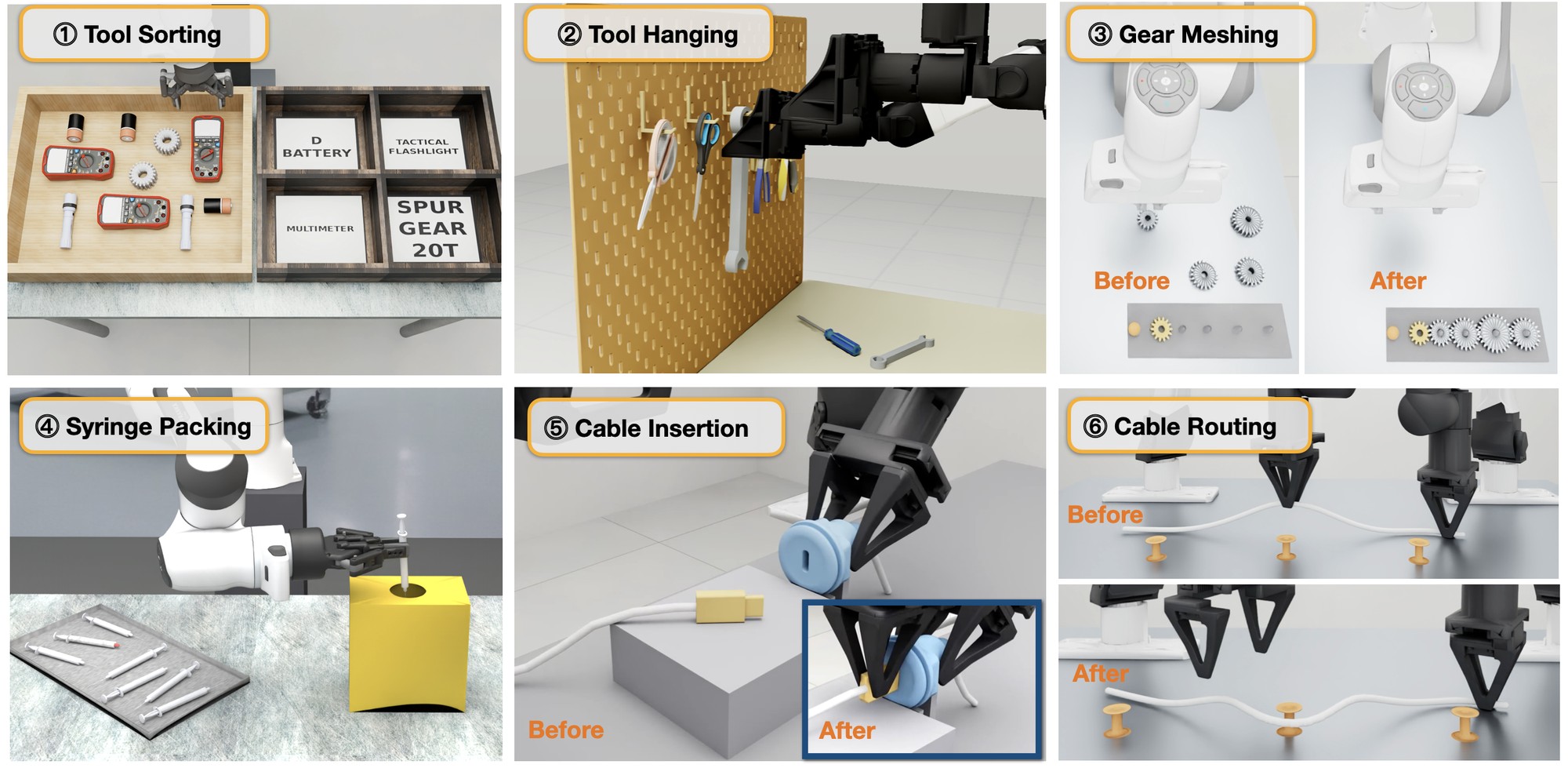
Fig. 1Overview. Inspired by industrial applications, VABAR includes six manipulation task classes:
(1) Tool Sorting, (2) Tool Hanging, (3) Gear Meshing, (4) Syringe Packing, (5) Cable Insertion and
(6) Cable Routing. The benchmark includes both single-arm and bimanual robot embodiments and evaluates
manipulation under specific tiers of geometric and physical variation. VABAR is open access and runs on
GPU workstations and on Isaac Lab Arena.
§ 1
Abstract
For robots to operate reliably in commercial and industrial applications, they must persistently perform
specific tasks with known variations in object shape and pose. To differentiate these settings from fixed
automation, we call this Variational Automation (VA). Recent work on agentic robotics
combines the interpretable robot programming of pretrained LLM and VLM coding agents with the open-world
adaptability of model-free policies.
We propose a general set of benchmark design criteria emphasising accessibility, repeatability, diversity,
relevance to agentic robotics and practical applications, physical realizability, resistance to benchmark
saturation, and computational efficiency. We instantiate these principles in six manipulation task classes
spanning industrial, medical and infrastructure applications: tool sorting, tool hanging, gear meshing,
syringe packing, cable insertion and cable routing.
We introduce the Variational Automation Benchmark for Agentic Robotics (VABAR), a new,
open, easily replicable, simulation-based manipulation benchmark for systematically evaluating agentic
robotics systems. Built fully on open-source tools, VABAR features detailed implementations using the
Newton physics engine, standardised task variations, difficulty tiers, success metrics, and a library of
33 generalizable skills with human-authored programmatic reference solutions. We provide initial baseline
evaluations using an open agentic manipulation harness, Graph-as-Policy (GaP), and an open version on
Isaac Lab Arena.
§ 2
Contributions
Five things this work puts on the table.
01 — Formulation
Variational Automation
A manipulation class between fixed automation and unconstrained general-purpose manipulation, in which persistent operational objectives must be achieved across a structured distribution of task instances.
02 — Method
Design principles
Practical criteria for evaluating agentic systems: accessibility, repeatability, controlled diversity, application relevance, physical realizability, resistance to saturation, and computational efficiency.
03 — Benchmark
Six task classes
Tool sorting, tool hanging, gear meshing, syringe packing, cable insertion and cable routing — with standardised variations, difficulty levels, success metrics, and support for single-arm Franka and bimanual YAM embodiments.
04 — Sandbox
Simulation, skills, references
For each task: a photorealistic simulation environment, 33 generalizable skills, and a human-authored reference solution expressed as a computation graph over the same skill library.
05 — Evaluation
Agentic baselines
Initial baseline evaluations characterising performance as task complexity and instance variation increase, establishing reference results and identifying remaining challenges for agentic manipulation.
§ 3
What a Variational Automation task is
A VA task class is a tuple. An instance is a draw from it. Admissibility — not randomness — is what makes
the draw meaningful.
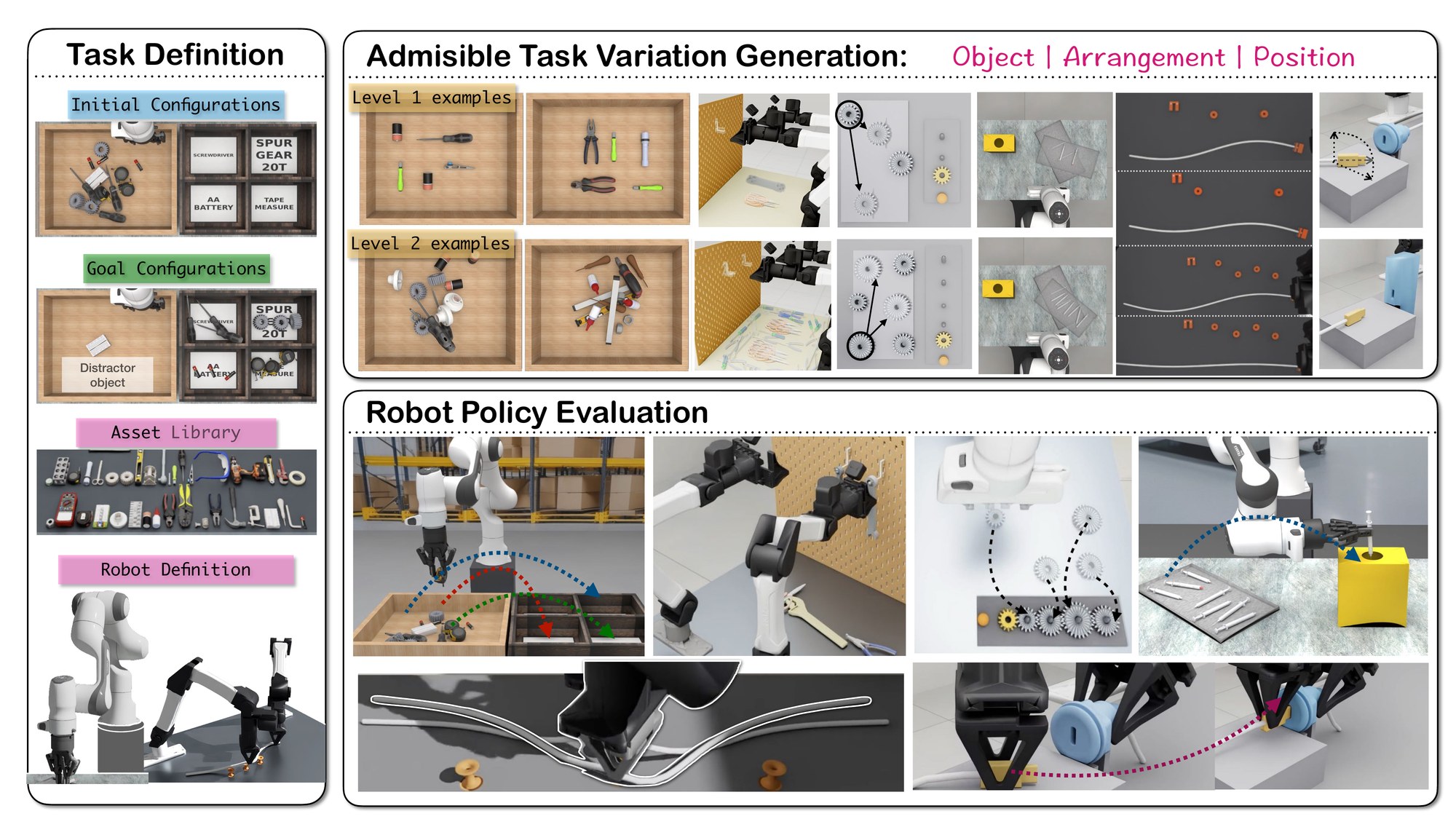
Fig. 2Overview of the VABAR evaluation framework. Left: tasks are specified by initial and goal
configurations, an asset library, and robot definitions. Top right: admissible task variations span objects,
arrangements and positions, with examples at two levels. Bottom right: robot policies are evaluated across
diverse manipulation tasks, including object sorting, tool hanging, gear assembly, insertion and cable routing.
T = (E, R, A, O, pO, S)
E
Environmental coordinate frames
R
Robot and gripper specification
A
Admissible initial assets, each with physical properties and collision mesh
O
Space of admissible object configurations
pO
Distribution over admissible configurations
S
Measurable success condition
An instance τi = {(aj, xj)}j=1..Ni ∈ O
names each instantiated asset aj ∈ A and its initial pose
xj ∈ SE(3), for all Ni objects and
fixtures in the scene. Instances are drawn τi ~ pO under a
controlled seed.
Five constraints on admissible variation
Task invariance. All generated instances remain instances of the same VA task.
Physical feasibility. Generated configurations satisfy physical constraints on object support,
collision and geometric consistency, preventing inadmissible initial scene configurations.
Robot feasibility. Variations are bounded by the operational workspace of the specified robot.
Object and fixture configurations are restricted to reachable regions, avoiding failures caused solely
by physically inaccessible configurations.
Controlled difficulty. Each task has levels of difficulty variation regimes; increasing
difficulty progressively broadens what the robot has to solve.
Skill preservation. Variations are designed so that instances across the same difficulty level
can be solved using the same underlying set of manipulation skills, or extensions of them.
The point of the constraint list: O is not defined by unconstrained scene
randomization. The variation space and its sampling distribution are designed to represent
meaningful changes in the operating conditions of an automation task, where variation is expected rather
than anomalous.
§ 4
Design criteria for agentic robotics benchmarks
A benchmark for agentic robotics has to evaluate task outcomes without prescribing a program representation
or agent architecture, so that generated-code, computation-graph, tool-use, learned-policy and hybrid systems
can be compared under common conditions. Seven criteria follow.
C1
Relevance to agentic robotics
Support agents that construct, test and revise robot programs from task specifications, with documented robot and tool interfaces and execution feedback for refinement — without prescribing a program representation.
C2
Application relevance
Tasks and variations reflect realistic operating requirements, with results predictive of real-world success, cycle time and intervention needs.
C3
Accessibility and clarity
Environments, task specifications, assets, metrics and variation parameters are publicly available and clearly documented, so independent researchers can reproduce and extend the evaluation.
C4
Controlled diversity
Each task specifies explicit variation axes and difficulty levels rather than relying solely on unconstrained randomization.
C5
Repeatability
Task generation and evaluation use controlled random seeds and standardised success criteria, supporting repeatable experiments and meaningful comparison between methods.
C6
Computational efficiency
Evaluation stays cheap enough to support repeated experimentation, sensitivity analysis and large-scale benchmarking.
C7
Durability
Systematic extensions of variation range and task complexity keep the benchmark informative as systems improve; extensions are versioned to preserve comparability with previously reported results.
§ 5
Task execution records
Task-level success says whether an execution achieved its objective, not where or why it failed. That matters
for agentic robotics, where execution feedback is used to diagnose failures, revise programs and introduce
recovery behaviours. VABAR records the evidence needed to relate outcomes to both the program's decisions and
the resulting physical interaction.
Physics statest
→
Observation & estimationot → ŝt
→
Decision & actionat
→
Physics outcomest+1, Ct
→
Verificationet+1
Fig. 3 — Diagnostic execution flow. Dashed: privileged simulator state.
Dotted: physics contact information used for diagnosis.
The four mappings that localise a failure
ot → ŝt
Perception or state-estimation failures.
ŝt → at
Program-generation, planning, skill-selection or decision failures.
at → (st+1, Ct)
Grasping, motion-execution, collision, contact or other physical-interaction failures.
(st+1, Ct) → et+1
Task verification, failure detection and recovery triggering.
Why contact is recorded separately from state
Object poses and velocities describe the resulting scene configuration; contact records describe how that
configuration arose. A failed placement may leave an object in an incorrect pose, while its contact history
reveals whether it collided with a fixture, was supported by another object, or became jammed. VABAR records
both so that failure attribution is grounded in the physical execution rather than in task-level success or
software error messages alone.
§ 6
What the benchmark ships
Four components hold the suite together: a standardised asset library, representative single- and dual-arm
embodiments, a declarative task specification, and multi-physics simulation support.
Asset library
55+ normalised assets
Industrial tools, mechanical components, medical supplies, fixtures, connectors and deformable objects. Assets are normalised in format, scale, appearance and collision geometry to support controlled object and geometric variation across task instances.
Robot embodiment
Single-arm Franka, bimanual YAM
Franka provides a widely adopted platform for reproducible tabletop manipulation; YAM enables tasks requiring coordinated bimanual interaction, particularly deformable-object manipulation.
Task specification
Declarative, extended BDDL
Tasks declare their objects, initial configurations, variations and success conditions. The Behavior Domain Definition Language is extended to represent both rigid and deformable objects as one specification across the full suite.
Physics
Rigid and deformable, unified
NVIDIA Newton provides unified rigid-body and deformable-body dynamics and their interactions, letting the suite span rigid manipulation, contact-rich assembly and insertion, and deformable tasks such as cable routing.
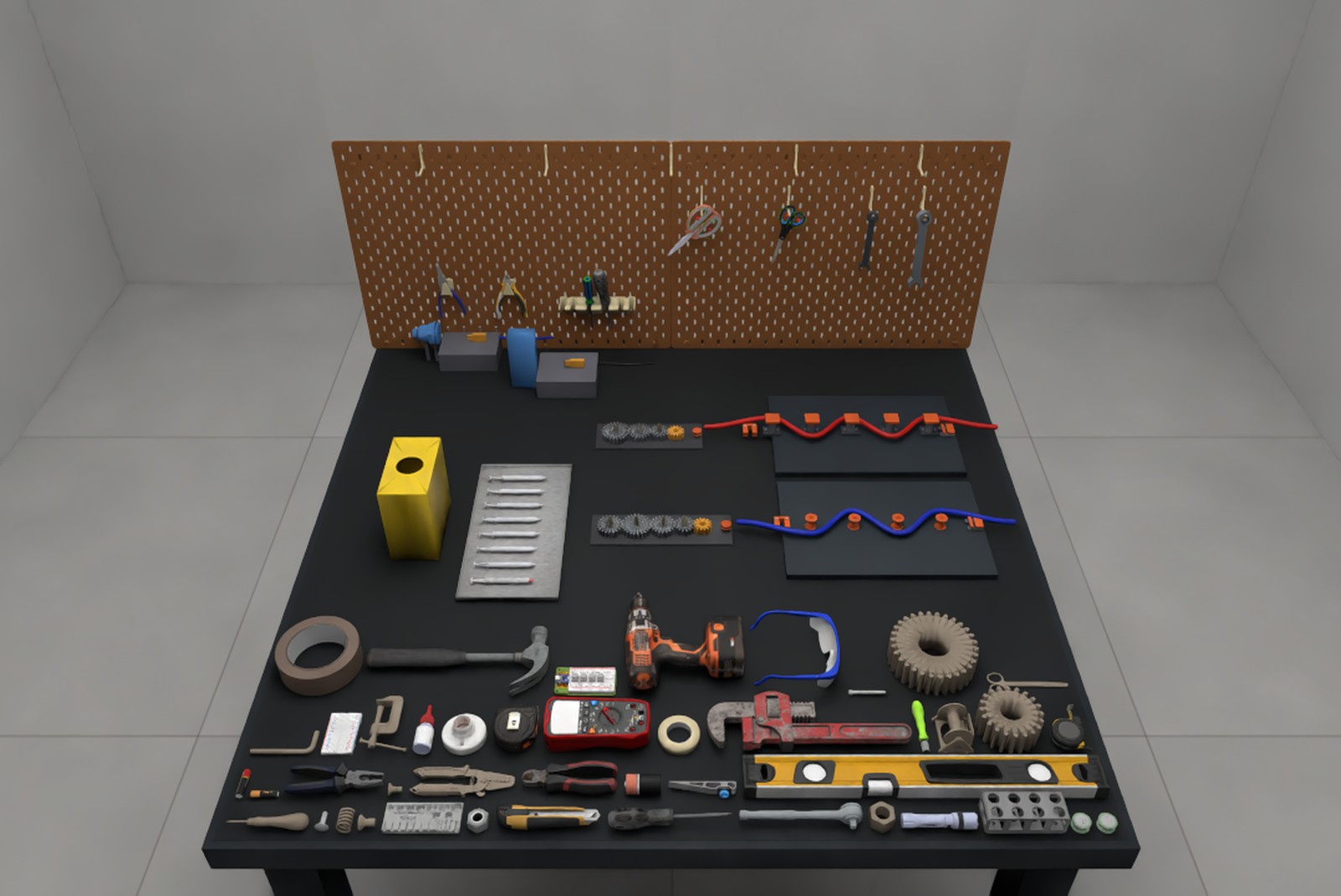
Plate AThe asset catalogue, on one bench. Every task's assets on a shared table, rebuilt from the sources the tasks themselves use rather than dressed for the photograph — the syringes carry the suite's own collision hulls, the gears and routing boards its own fixtures. Normalising format, scale, appearance and collision geometry is what lets a variation axis mean the same thing in every task that uses it.
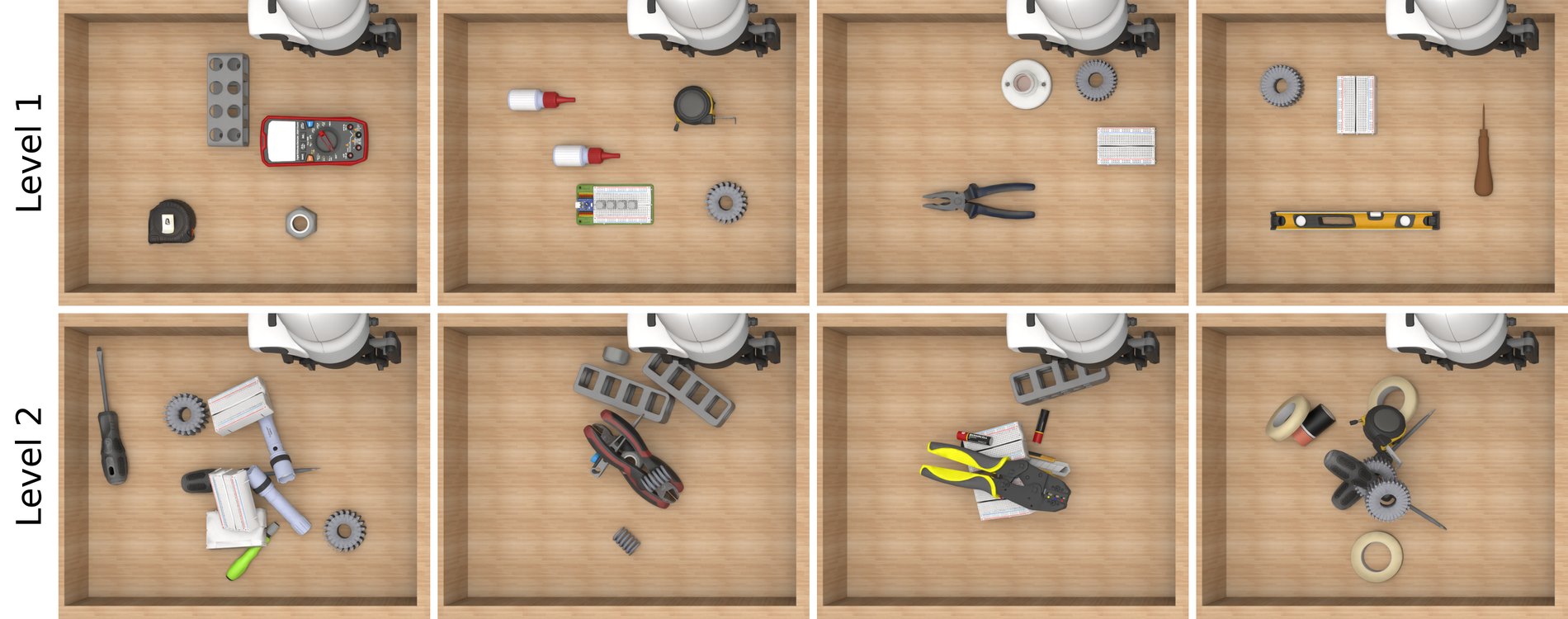
Plate BControlled difficulty, shown on Tool Sorting. Top row: Level 1, singulated tools with no distractors.
Bottom row: Level 2, where tools overlap and grasp selection must account for what is on top of what.
Each column is an independently seeded instance of the same task class.
§ 7
The six task classes
Each class fixes an operational objective and an application setting, then names the axes along which
instances vary. Clips are path-traced replays of recorded episodes, played back faster than real time;
success figures are the human-authored reference graph on Newton.
Table ITask difficulty levels across the VABAR suite.
Task
Level 1
Level 2
1 · Tool Sorting
Singulated tools; no distractors
Cluttered tools
2 · Tool Hanging
One tool; known fixture pose
Multiple tools and fixture types; randomized poses
3 · Gear Meshing
Assemble two gears
Assemble three gears
4 · Syringe Packing
Singulated targets
Cluttered scenes
5 · Cable Insertion
Fixed, visible port; nearby connector with small misalignment
Randomized port pose; moderate connector misalignment
6 · Cable Routing
2–3 widely spaced pegs; short route; low turning angle
The robot must pick up one or more industrial tools — wrenches, screwdrivers, hammers, scissors — and hang or insert them into designated hooks, clips or slots on a pegboard. Variation comes from tool type, the number of tools, initial tool pose and holder pose.
Level 1
One tool with a known fixture pose.
Level 2
Multiple tools and multiple fixture types at randomized poses.
The task input is gears and axles. The robot must pick up multiple gears, assemble them onto axles so that they properly mesh, and press a button to activate the mechanism. Variation covers the number of gears, gear size and initial gear poses. To ensure physically valid instances, scenes can be initialised from a valid assembled configuration before selected gears are removed and repositioned.
The robot must place syringes into a disposal container while avoiding distractor objects. Instance variation includes the number of objects and the disposal box type.
The robot must pick up a connector, align it with a USB-C port and fully insert it. Instance variation includes the position and orientation of the connector and the port.
Level 1
Connector begins near a fixed, clearly visible port with small positional and angular misalignment.
Level 2
Randomized port pose with moderate connector misalignment.
The robot must route a flexible cable around a specified ordered sequence of cylindrical fixtures mounted on a planar routing board. The task varies the number, position and spacing of pegs; the ordered target sequence; cable length; initial cable configuration; cable slack and curvature; endpoint position; and the 3D pose of the routing board.
Level 1
2–3 widely spaced pegs, a short route, low total turning angle.
Every clip below is a flip-book of initial conditions, not a trajectory. Each frame is one
independently seeded instance of the same task class, path traced from the scene a policy actually opens on,
and held for half a second. Level 1 and Level 2 run the same sampler under different bounds — what changes
between the two columns is the width of the admissible region, not the objective.
Task 01
Tool Sorting
The tools present, their poses, and tool density.
Tool type · clutter · bin occupancy · overhead camera
Level 1Singulated tools, no distractors. 7 instances · 0.5 s eachLevel 2Cluttered tools that overlap and occlude. 8 instances · 0.5 s each
Task 02
Tool Hanging
Tool type, the number of tools, initial tool pose, and holder pose.
Tool type · fixture type · object and fixture poses · side camera
Level 1One tool, known fixture pose. 8 instances · 0.5 s eachLevel 2Multiple tools and fixture types at randomized poses. 8 instances · 0.5 s each
Task 03
Gear Meshing
The number of gears, gear size, and initial gear poses.
Gear count · gear size · initial pose · front camera
Level 1Two gears to assemble. 8 instances · 0.5 s eachLevel 2Three gears to assemble. 8 instances · 0.5 s each
Task 04
Syringe Packing
The number of objects and the disposal box type.
Syringe type · clutter · disposal geometry · agent view camera
Level 1Singulated target objects. 12 instances · 0.5 s eachLevel 2Cluttered scenes with diverse syringe types. 12 instances · 0.5 s each
Task 05
Cable Insertion
The position and orientation of both the connector and the port.
Connector pose · port pose · top down camera
Level 1Fixed, visible port; connector nearby with small misalignment. 8 instances · 0.5 s eachLevel 2Randomized port pose; moderate connector misalignment. 8 instances · 0.5 s each
Task 06
Cable Routing
Peg number, position and spacing; the ordered target sequence; cable length, slack and curvature; and the 3D pose of the board.
Fixture layout · route · cable type · overhead camera
Level 12–3 widely spaced pegs, short route. 24 instances · 0.5 s eachLevel 24–6 moderately spaced pegs, multiple turns. 24 instances · 0.5 s each
Instances are drawn under a controlled seed, so re-running a document reproduces the same scenes. Counts differ
by task because each document declares its own episode count.
§ 9
The skill library
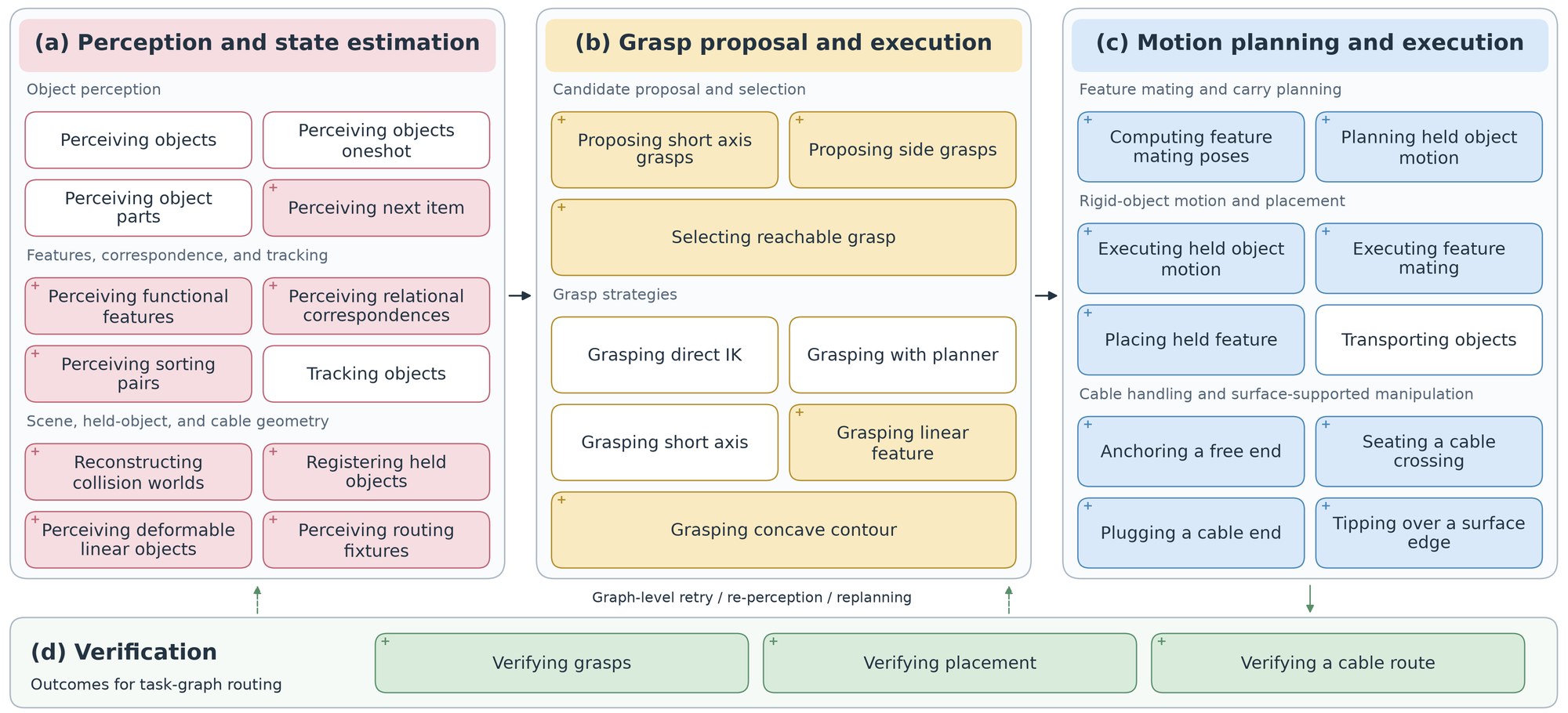
VABAR extends the Modular Open Robot Skill Library with reusable procedures for functional-feature
manipulation, constrained placement and deformable cable handling. Building on existing perception, grasp
generation and collision-aware planning primitives, the extensions provide metric feature localization,
source–destination correspondence, in-hand registration and staged feature mating. Cable skills estimate and
track ordered 3D centerlines and support anchoring, routing and terminal placement.
Fig. 4VABAR skill library. The 33 skills span perception, grasping, motion planning and
execution, and verification. Coloured cards marked “+” identify 25 added skill bundles relative to the May
Graph-as-Policy library; white cards denote eight retained counterparts. Additions support
functional-feature manipulation, constrained placement, cable handling and execution checks.
§ 10
Baseline experiments
Three questions drive the evaluation: how do success rate and cycle time change as the magnitude and
dimensionality of task variation increase; what are the failure modes; and can agentic systems reuse skills
as task difficulty changes.
Two simulator implementations
Newton. VABAR is developed on the Newton physics engine. Success conditions extend the
Behavior Domain Definition Language to represent both rigid and deformable objects as a common
specification across the full task suite.
Isaac Lab Arena (ILA). A second implementation runs on NVIDIA Isaac Lab Arena, a framework
for composing, executing and analysing policy-evaluation benchmarks with GPU acceleration. ILA supplies
environment composition — including object placement from semantic spatial relationships — multiple physics
backends including Newton, parallel GPU evaluation, and robustness analysis across environment and task
variations. It is executed on a cluster of NVIDIA L40 GPU nodes. The two implementations differ in texture,
lighting, assets and robot implementation.
Four evaluated systems
GaP (Human–Newton). A manually specified computation graph connecting skills from the modular
skill library, executed on the Newton implementation.
GaP (Human–ILA). The same manually specified graph executed on the ILA stack, measured on its own
instances at N = 40 per variant.
Claude Code. A general-purpose coding agent (Claude Code with Claude Opus 5) with no
robotics-specific harness or skill library.
GaP. The computation graph is autonomously generated by the same model and connected to the
skill library. Systems 1 and 4 share the same perception, skill, planning and execution modules, so the
gap between them reflects graph composition and parameterization alone.
Each task–difficulty combination contains N = 30 independently generated instances per evaluation
condition, shared across conditions.
Table IIPerformance of agentic policy-generation systems and diagnostic controls across VABAR tasks and difficulty levels.
Task
Diff.
a. GaP (Human–Newton)
b. GaP (Human–ILA)
c. Claude Code
d. GaP
Succ.
Cyc. (s)
Succ.
Cyc. (s)
Succ.
Cyc. (s)
Succ.
Cyc. (s)
Tool Sorting
L1
47.1
421.6
20.0
555.0
0.0
—
26.7
134.2
L2
33.7
913.8
—
—
0.0
—
13.3
232.3
Tool Hanging
L1
86.7
86.1
67.5
98.3
16.7
96.2
33.3
81.5
L2
81.7
158.4
50.0
138.3
10.0
190.8
10.0
270.9
Gear Meshing
L1
100.0
165.9
87.5
198.9
0.0
—
70.0
156.6
L2
90.0
235.5
80.0
381.3
0.0
—
60.0
284.1
Syringe Packing
L1
87.0
228.8
52.5
939.0
0.0
—
33.3
371.1
L2
63.0
472.3
40.0
1810.0
0.0
—
12.1
652.2
Cable Insertion
L1
86.7
78.8
97.5
104.9
0.0
—
36.7
79.0
L2
30.0
74.2
17.5
118.8
0.0
—
23.3
80.5
Cable Routing
L1
46.7
116.0
50.0
145.9
3.3
120.7
36.7
50.8
L2
46.7
189.8
5.0
151.5
0.0
—
13.3
120.3
Succ.: success rate (%); bar length encodes the same number. Cyc.: median
cycle time in simulated seconds among successful trials; a dash means no successful trial to take a median
over. GaP (Human) is a manually specified computation graph executed on the same perception,
skill, planning and execution stack as GaP. Each task–difficulty condition contains N = 30 independently
generated instances shared across all evaluation conditions, except GaP (Human–ILA), measured
on its own instances at N = 40 per variant.
How success is counted
The evaluation unit is set by the dependency structure of each task. For tasks composed of repeated
manipulation attempts that are independent by construction — sorting or hanging independently sampled
objects — each object-level attempt is a trial, and success rate is the fraction of objects successfully
manipulated. This avoids assigning zero success to an otherwise largely successful multi-object execution.
In tasks such as Gear Meshing, later insertions are conditioned on the states produced by earlier ones:
inserting one gear changes the geometry and contact configuration the next gear meets. Multiple cable
insertions count as separate trials only when each is independently initialised or reset. For sequential,
state-dependent tasks the complete instance is the evaluation unit, with subgoal-level success reported as
a diagnostic.
Cycle time is the simulated time elapsed from policy start until success, failure or
timeout. The table reports the median among successful trials only.
For each unsuccessful execution we record the observed failure outcome and assign a primary failure source
when supported by execution evidence. For cascading failures we attribute the execution to the earliest
supported failure that explains the subsequent outcome. Failure-source percentages are conditioned on
unsuccessful executions.
§ 11
Where the failures are
Aggregate success rates do not say which part of the stack becomes unreliable as variation grows. Unsuccessful
GaP executions decompose into perception, grasp and motion-planning failures — one primary source each.
PerceptionGraspMotion
0%25%50%75%100%
Perc.GraspMotion
Table IIIFailure decomposition of GaP across VABAR difficulty levels, as a share of unsuccessful executions.
Gear Meshing attribution is per failed gear; syringe and cable attribution is per failed attempt.
Gear Meshing Level 1 had no failures to attribute. Segment labels carry the exact percentages.
Finding a
The harness and skill library carry real weight
Using the same underlying language model, GaP achieves higher success than Claude Code in 11 of 12
task–difficulty conditions. On Gear Meshing it reaches 70.0% and 60.0% at Levels 1 and 2 where Claude Code
records no successful trial. GaP still sits below the human-authored graphs on Newton in every condition,
despite sharing the same perception, skill, planning and execution stack — so reliable skill composition
and parameterization remain open problems for autonomous policy generation. These comparisons evaluate the
combined system; they do not isolate the harness from the skill library.
Finding b
Most errors are motion planning
In low-variation settings, perception and grasp generation are near-perfect across most tasks, leaving
motion planning and trajectory execution as the primary failure source. As variation increases the
dominant mode branches with the physics of the task: in cluttered scenes and deformable-object
manipulation — syringe packing, cable routing — perception and grasping degrade sharply under visual
occlusion and unmodelled cable mechanics. In precision-contact tasks such as USB-C insertion, state
estimation stays robust while motion planning and fine insertion alignment account for nearly all
failures.
Finding c
A detailed physics model supports diagnosis
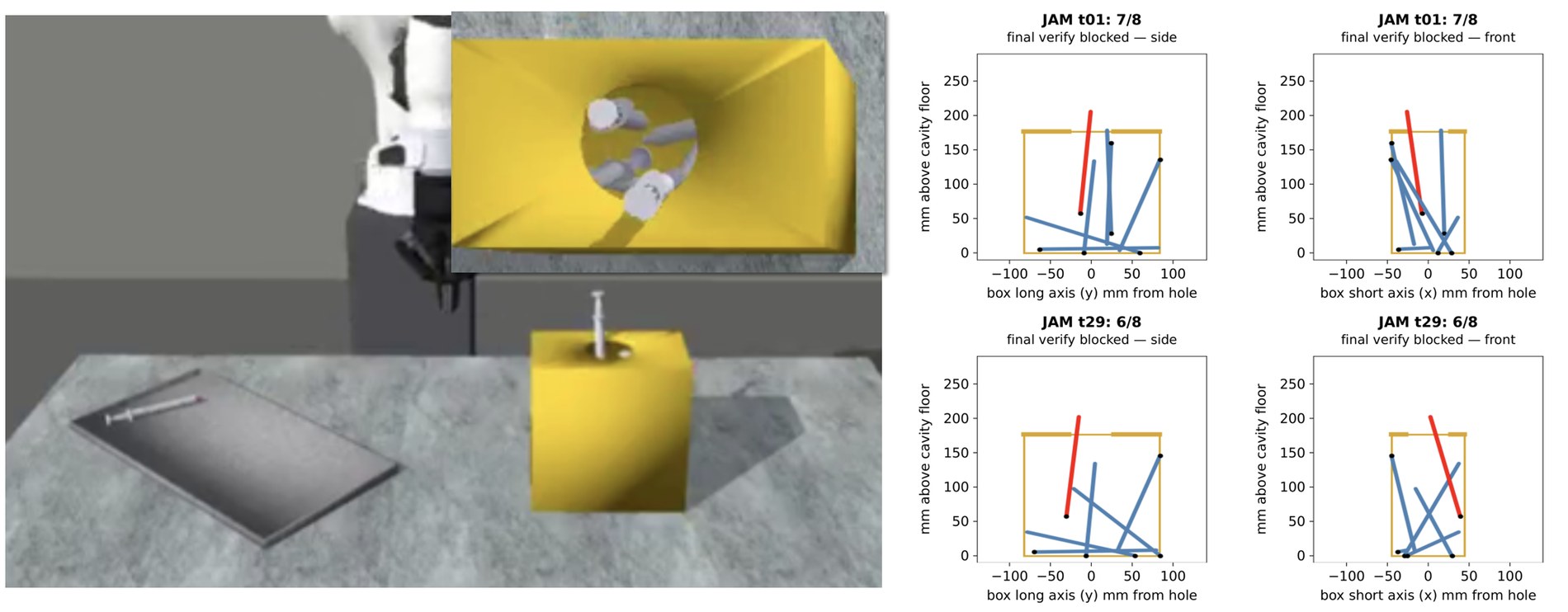
Pairing task-level verification with simulator ground-truth inspection identifies the physical conditions
behind a failure. Two jammed syringe-packing episodes, t01 and
t29, terminate with final verification reporting blocked
and 7/8 and 6/8 syringes posted. In both, a syringe straddles the lid plane — needle end inside the cavity,
opposite end above the opening — consistent with incomplete passage into the container. The surrounding
syringes sit in different configurations, showing execution-induced variation: earlier placements alter the
geometry encountered by later insertions.
Finding d
Skill reuse is extensive across task classes
Despite spanning rigid-object manipulation, contact-rich assembly, precision insertion and
deformable-object manipulation, VABAR policies reuse skills heavily. Core robot and perception
capabilities — end-effector pose retrieval, SAM3-based segmentation — are shared across all six task
classes, and higher-level semantic skills are reused across tasks with different objects but similar
manipulation structure: Tool Hanging and Syringe Packing both rely on held-object motion,
functional-feature perception, object registration and feature mating. Increasing task diversity does not
necessarily require an entirely new set of skills. The central challenge is selecting the right skills,
parameterizing them for the current geometry and task state, and composing them into task-specific
behaviour.
Fig. 5Physical-state inspection supports failure diagnosis. Left: simulated syringe-packing
scene with a top-down inset. Right: ground-truth projections of jammed episodes t01
and t29. Red segments highlight syringes straddling the lid plane; blue segments
show other syringes, black dots mark needle ends, and gold outlines indicate container geometry.
The jam, recorded
ClipEpisode t01, the jam that Fig. 5 projects. Scene view alongside the container mouth.
Recovery behaviour, with and without the unjam skill
Without the unjam skillVerification reports blocked and the graph aborts. Speed and run label are burned into the frame.With the unjam skillThe blocked insertion triggers a push-and-re-verify recovery, and the episode completes.
§ 12
Materials
VABAR is built entirely on open-source tools and runs on a GPU workstation as well as on Isaac Lab Arena.
Everything below is released with the paper; links are withheld here because they would identify the authors
during double-blind review.
Code
Benchmark and harness
Task environments, instance generator, evaluator and baseline runner, on both the Newton and ILA implementations.
Assets
Standardised library
55+ assets normalised in format, scale, appearance and collision geometry.
Skills
33 generalizable skills
Perception, grasping, motion planning and execution, and verification — with human-authored reference graphs per task.
Instances
Seeded instance sets
The N = 30 instance sets per task–difficulty cell used for every reported number.
Citation
@inproceedings{anonymous2027vabar,
  title     = {VABAR: A Variational Automation Benchmark
               for Agentic Robotics},
  author    = {Anonymous},
  booktitle = {Under review, IEEE International Conference on
               Robotics and Automation (ICRA)},
  year      = {2027},
  note      = {Anonymous submission}
}